
Workday Adaptive Planning Course Guide – Budgeting, Forecasting, Financial Modeling, Reporting & Analytics
Table of Contents
The Workday Adaptive Planning course helps learners understand modern financial planning, budgeting, and forecasting using a powerful cloud-based FP&A tool. Workday Adaptive Planning is widely used by companies to replace manual Excel planning with automated, accurate, and real-time financial planning. This course guide explains how organizations plan budgets, create forecasts, and make better business decisions using Workday Adaptive Planning.
In this Workday Adaptive Planning course guide, you will learn the basics as well as advanced concepts of planning and analysis. The guide covers important topics such as driver-based budgeting, rolling forecasts, scenario planning, and version management. It also explains financial modeling concepts including revenue planning, expense planning, cash flow forecasting, and what-if analysis in a simple and easy-to-understand way.
What is Workday Adaptive Planning? (Complete Overview)
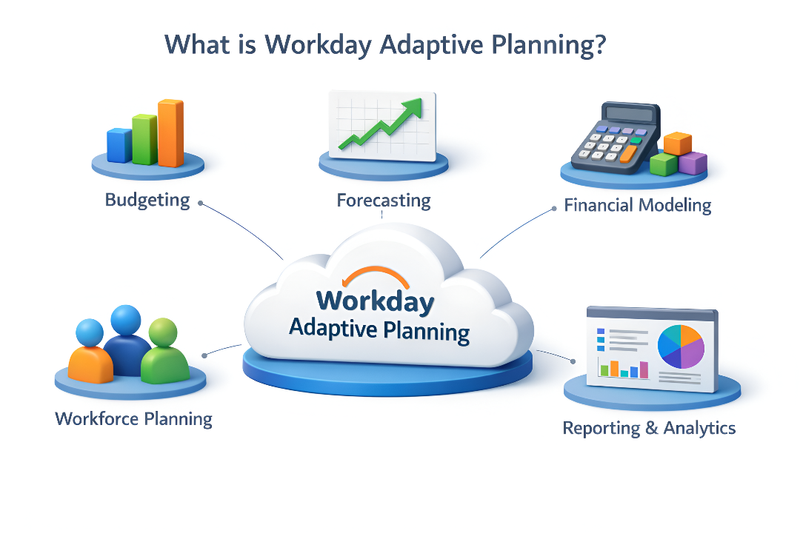
Workday Adaptive Planning is a cloud-based financial planning and analysis (FP&A) solution that helps organizations manage budgeting, forecasting, financial modeling, and reporting in a single platform. It is part of the broader Workday ecosystem and is used by finance teams to plan, analyze, and make better business decisions using real-time data.
Unlike traditional planning methods that depend heavily on spreadsheets, Workday Adaptive Planning provides a centralized system where data is updated automatically and shared across teams. This reduces manual work, improves accuracy, and allows businesses to respond quickly to changes in the market. It supports multiple planning areas such as financial planning, workforce planning, sales planning, and operational planning, making it suitable for both mid-sized and large enterprises.
For learners, understanding what Workday Adaptive Planning is forms the foundation of any Workday Adaptive Planning course, as it introduces the core concepts of modern, cloud-based planning and analytics.
Why Use Workday Adaptive Planning for FP&A?
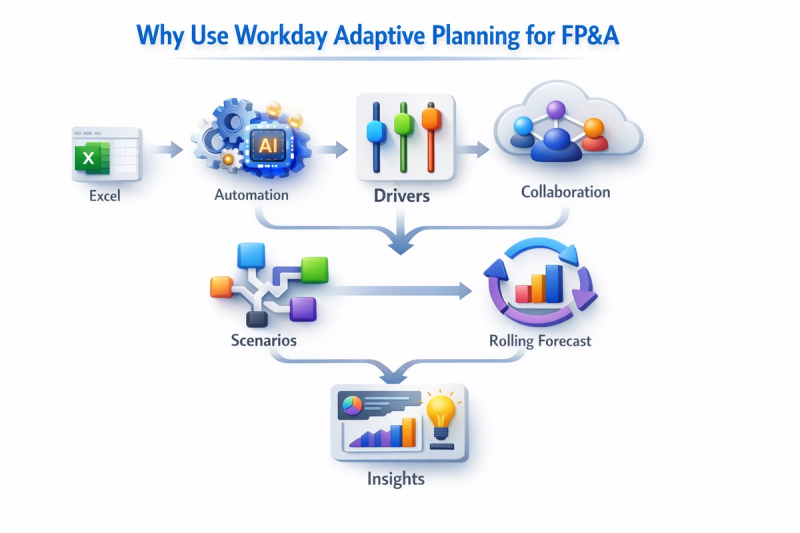
Finance and FP&A teams use Workday Adaptive Planning because it simplifies complex planning processes and improves decision-making. Traditional FP&A processes are slow, manual, and error-prone due to heavy reliance on Excel. Workday Adaptive Planning solves these problems by offering automation, real-time collaboration, and powerful analytics.
One of the biggest advantages of using Workday Adaptive Planning for FP&A is driver-based planning. This allows finance teams to create models based on business drivers such as headcount, revenue growth, or cost assumptions instead of static numbers. As a result, forecasts become more accurate and easier to update.
Workday Adaptive Planning also supports rolling forecasts, scenario planning, and what-if analysis. FP&A professionals can quickly compare multiple scenarios, analyze risks, and provide strategic insights to leadership. This makes the platform highly valuable for companies that want agile planning and faster financial close cycles.
Workday Adaptive Planning Architecture & Components
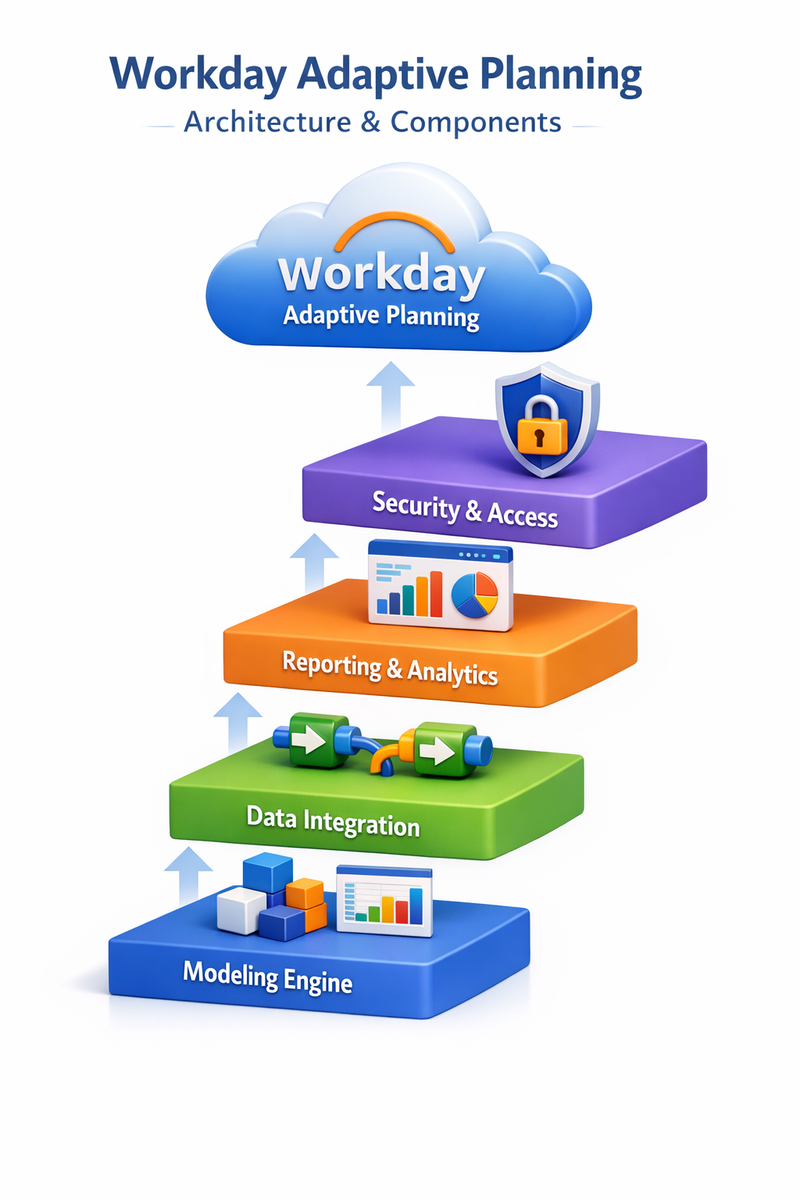
The architecture of Workday Adaptive Planning is fully cloud-based, which means users can access it securely from anywhere without managing complex infrastructure. The platform is designed to scale as organizations grow and can handle large volumes of financial and workforce data.
Key architectural components include:
- Modeling Engine: Used to build budgeting, forecasting, and financial models.
- Data Integration Layer: Connects Adaptive Planning with Workday Financials, HCM, ERP systems, and external data sources.
- Reporting & Analytics Layer: Enables dashboards, standard reports, and visual analytics.
- Security & Access Control: Manages user roles, permissions, and audit trails.
This modular architecture ensures high performance, data accuracy, and strong governance. For learners, understanding the architecture helps explain how planning, data, and reporting work together inside the platform.
Key Features of Workday Adaptive Planning
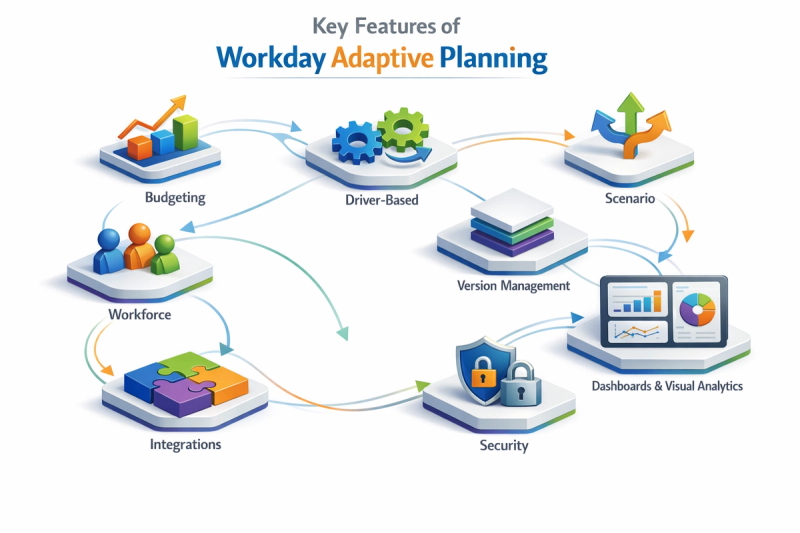
Workday Adaptive Planning offers a wide range of features that support end-to-end planning and analysis. Some of the most important features include:
- Budgeting and Forecasting: Create annual budgets, rolling forecasts, and long-term plans.
- Driver-Based Planning: Build flexible models using business drivers.
- Scenario and What-If Analysis: Compare best-case, worst-case, and expected scenarios.
- Workforce Planning: Plan headcount, compensation, and workforce costs.
- Version Management: Maintain multiple versions of plans for comparison.
- Dashboards and Visual Analytics: Track KPIs using charts and interactive dashboards.
- Integrations: Seamless integration with Workday Financial Management, HCM, and other ERPs.
- Security and Audit Controls: Role-based access and full audit trails.
These features make Workday Adaptive Planning a powerful tool for finance teams and a high-demand skill for professionals enrolling in a Workday Adaptive Planning course.
Difference Between Workday Adaptive Planning and Excel-Based Planning
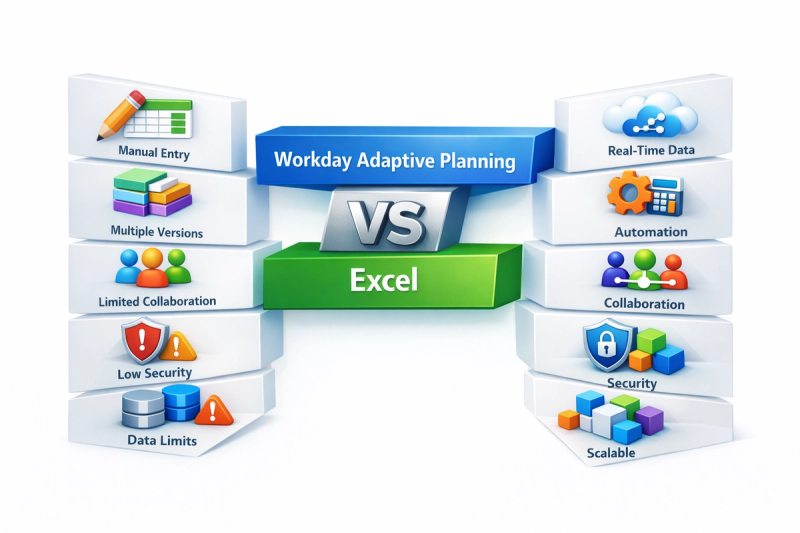
One of the most common questions learners ask is the difference between Workday Adaptive Planning and Excel. While Excel is flexible and familiar, it has major limitations when used for enterprise-level planning.
Excel-based planning often suffers from:
- Manual data entry and errors
- Multiple versions of the same file
- Limited collaboration
- Poor audit control
- Difficulty handling large datasets
Workday Adaptive Planning, on the other hand, offers:
- Centralized and real-time data
- Automated calculations and updates
- Multi-user collaboration
- Strong security and audit trails
- Scalable models for large organizations
This shift from Excel to Adaptive Planning is one of the main reasons companies invest in the platform. For professionals, learning this transition is a key outcome of any Workday Adaptive Planning course, as it reflects real-world business needs.
Budgeting Process in Workday Adaptive Planning
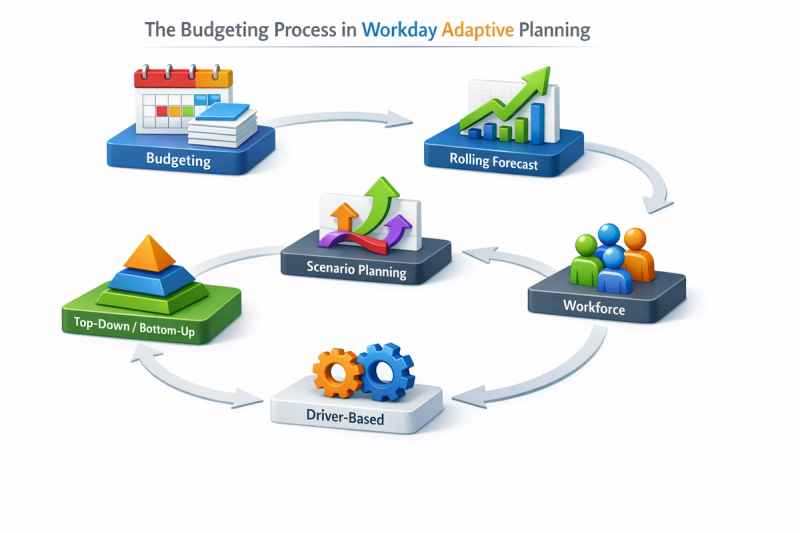
The budgeting process in Workday Adaptive Planning helps organizations move away from manual spreadsheets and adopt a structured, cloud-based planning approach. Finance teams can create annual, quarterly, or monthly budgets while managing departments, cost centers, and business units in a single system. Workday Adaptive Planning improves accuracy, reduces errors, and allows real-time collaboration, making budgeting faster and more reliable for growing businesses and large enterprises.
Rolling forecasts and scenario planning play a key role in modern financial planning. Instead of relying on fixed annual budgets, rolling forecasts allow finance teams to update projections regularly based on actual results and changing market conditions. Scenario planning helps organizations compare multiple outcomes such as best-case, worst-case, and expected scenarios. This enables better risk management, faster decision-making, and stronger financial control in dynamic business environments.
Top-down and bottom-up budgeting approaches can be used together in Workday Adaptive Planning to create balanced and realistic budgets. Leadership can set high-level financial targets using a top-down approach, while departments contribute detailed inputs through bottom-up budgeting. Workday Adaptive Planning makes it easy to align strategic goals with operational plans, ensuring transparency, accountability, and consistency across the organization.
Driver-based planning and workforce planning significantly improve forecasting accuracy in Workday Adaptive Planning. Driver-based planning uses key business drivers such as revenue growth, headcount changes, or operational volume to automatically calculate budgets and forecasts. Workforce planning and headcount forecasting help organizations plan salaries, hiring, and resource costs more effectively, ensuring alignment between financial planning and workforce strategy.
Real-World Use Cases of Workday Adaptive Planning
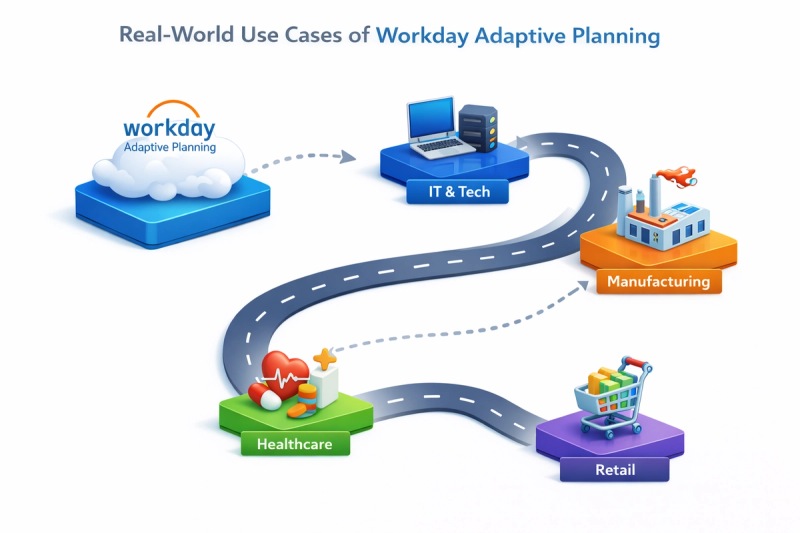
Workday Adaptive Planning is widely used by organizations of all sizes to improve financial planning, forecasting, and business decision-making. Unlike traditional spreadsheet-based planning, Workday Adaptive Planning offers a centralized, cloud-based platform that enables real-time collaboration, automation, and advanced scenario analysis. By understanding real-world use cases, businesses and learners can clearly see how Workday Adaptive Planning delivers measurable value across different industries, enterprise environments, and fast-growing organizations.
One of the biggest strengths of Workday Adaptive Planning is that it is industry-agnostic and highly configurable to meet specific business requirements. In IT and technology companies, Adaptive Planning is commonly used for revenue forecasting, project cost tracking, and workforce planning to manage rapid growth and changing demand. Manufacturing organizations rely on Workday Adaptive Planning for production planning, cost modeling, demand forecasting, and margin analysis. In the healthcare and life sciences sector, it supports budget control, staffing forecasts, compliance reporting, and long-term financial planning. Retail and e-commerce businesses use Adaptive Planning for sales forecasting, inventory planning, seasonal scenario analysis, and profitability tracking.
These industry-specific use cases demonstrate how Workday Adaptive Planning adapts to complex financial and operational challenges while maintaining accuracy, flexibility, and control. Whether an organization is scaling operations, improving forecast accuracy, or enabling data-driven decision-making, Workday Adaptive Planning provides a powerful and future-ready solution for modern FP&A teams.
Future Trends & Advanced Concepts
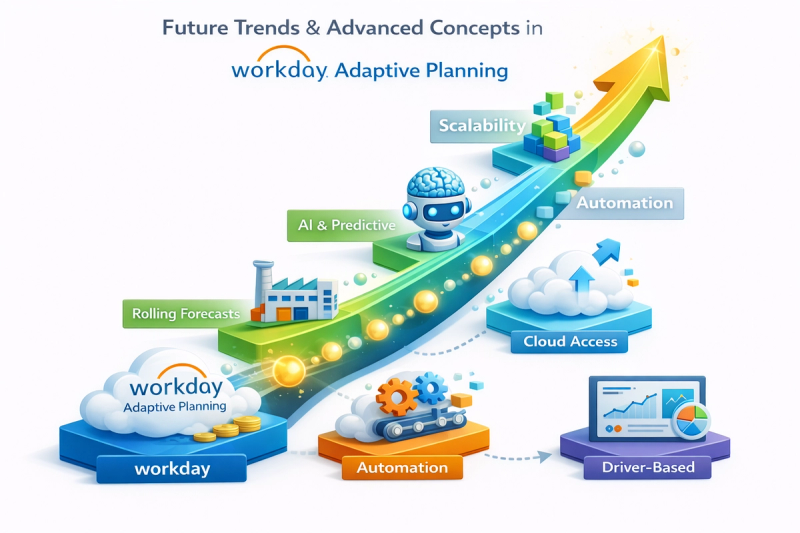
The future of financial planning and analysis (FP&A) is becoming more flexible and business-focused, and Workday Adaptive Planning plays an important role in this change. Companies no longer depend only on yearly budgets. Instead, they use rolling forecasts and scenario planning to adjust plans when business conditions change. Workday Adaptive Planning helps finance teams work closely with business leaders and provide clear insights that support faster and better decisions.
New technologies like AI, predictive analytics, and automation are making planning easier and more accurate. Workday Adaptive Planning uses data to predict trends and help teams understand what may happen in the future. Automation reduces manual work such as updating numbers and creating reports. Because it is a cloud-based tool, teams can access data anytime, work together in real time, and rely on regular system updates and strong data security.
As companies grow, planning becomes more complex, and Workday Adaptive Planning is built to handle this growth smoothly. It supports large data volumes, multiple departments, and different business units without slowing down performance. By following simple best practices like using driver-based planning, regular forecasting, and clear dashboards, organizations can improve accuracy, control costs, and make smarter business decisions.
Conclusion
Workday Adaptive Planning has become an essential tool for modern financial planning and analysis (FP&A). This course guide has explained how organizations use Workday Adaptive Planning for budgeting, forecasting, financial modeling, reporting, and analytics in a structured and cloud-based way. By moving away from manual Excel-based planning, companies gain better accuracy, real-time collaboration, and faster decision-making. From core concepts and architecture to budgeting processes, real-world use cases, and future trends, this guide provides a complete understanding of how Workday Adaptive Planning works in real business environments.
For learners and professionals, a Workday Adaptive Planning course opens strong career opportunities in FP&A, finance transformation, and enterprise planning roles. Skills such as driver-based planning, rolling forecasts, scenario analysis, and workforce planning are highly valued by organizations across industries. As companies continue to adopt cloud-based and data-driven planning tools, the demand for Workday Adaptive Planning professionals will keep growing.
By learning Workday Adaptive Planning through a structured and practical approach, you can build future-ready skills and stay competitive in the finance job market. Whether you are a beginner, finance professional, or FP&A analyst, investing in a Workday Adaptive Planning course is a smart step toward long-term career growth and success.